
Flake Floor Systems Explained: Base Coat, Broadcast and Topcoat Done Right
Flake (chip) floor systems are the most requested decorative resin finish in garages, showrooms, locker rooms and commercial spaces — tough, slip-resistant, and forgiving of minor slab imperfections. Here is how a flake system is actually built, the choices that change the result, and where installers go wrong.
How a flake system is built
- Prep — grind to the profile the base coat requires and vacuum clean (see the CSP guide). Test moisture first (how).
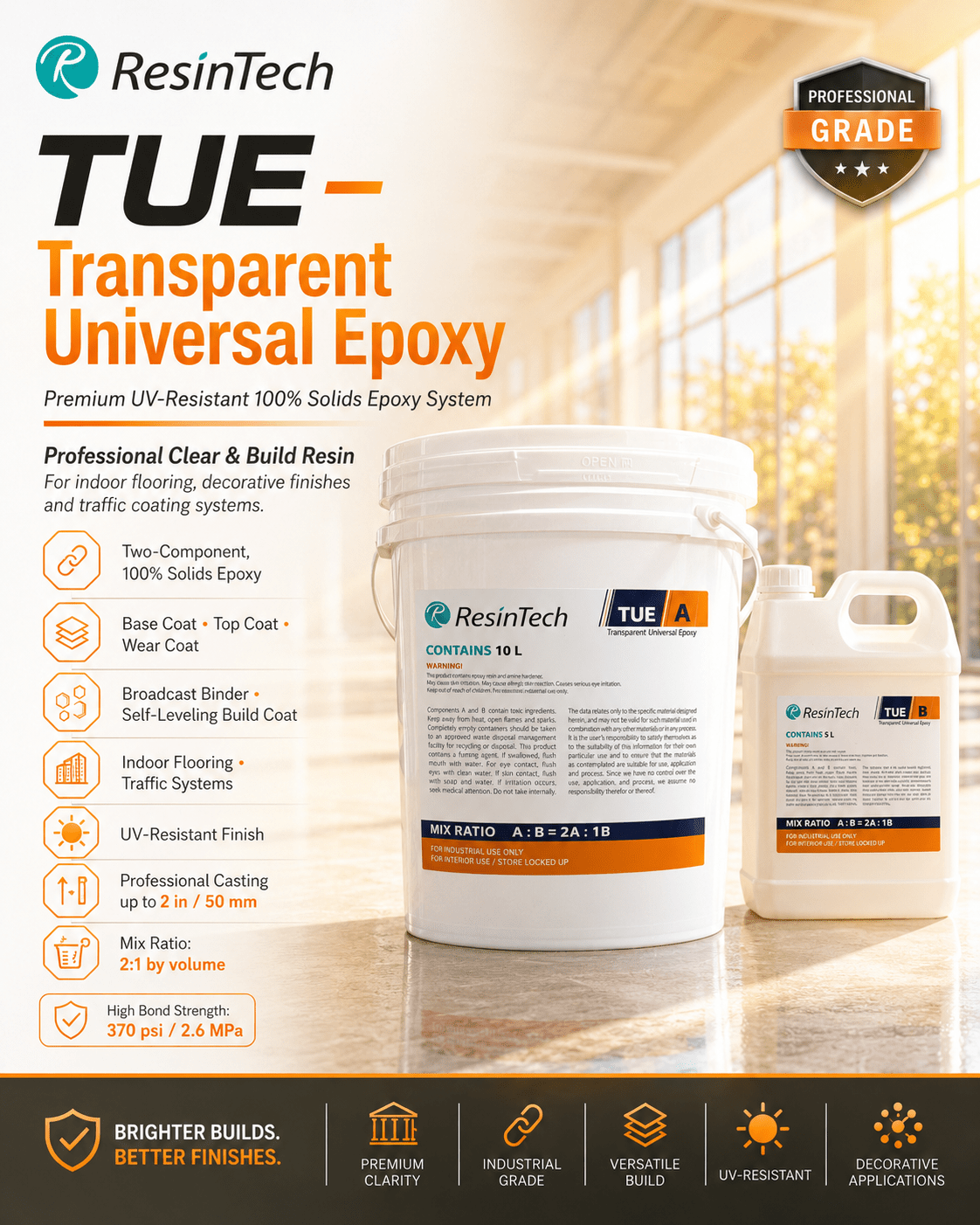
- Base coat — a pigmented or clear epoxy such as ResinTech TUE (100% solids) applied at the specified film build.
- Broadcast — while the base is wet, flakes such as Canoflake 3/8" blends are thrown into it — either to full refusal (surface completely covered, the standard for durability) or as a partial/accent broadcast.
- Scrape & vacuum — after cure, loose flake is scraped off, recovered and vacuumed so the surface is even.
- Topcoat — one or two clear coats lock the flake down. A UV-stable polyaspartic like ResinTech HPP is the common choice for colour stability and fast return to service (why).
Choices that change the result
Flake size: 1/4" reads finer and hides less; 3/8" is the all-purpose standard; 1" reads bold and rustic. Full vs partial broadcast: full-refusal broadcasts wear better and hide slab blemishes; partial broadcasts save flake but show more base coat and telegraph imperfections. Texture: the amount of topcoat controls slip resistance — a single flood coat leaves more texture, a double coat gives a smoother, easier-to-clean finish. Match texture to the use: more grip on exterior steps and wet areas, smoother in showrooms.
Where flake jobs fail
- Skipped prep or moisture testing — the base coat lets go and the whole sandwich comes with it.
- Broadcasting late — flakes thrown into a tacky base don't anchor and shed under traffic.
- Starving the topcoat — too little clear leaves flake edges proud, which whiten and wear grey.
- Epoxy-only clear coats outdoors — ambering. Use an aliphatic (UV-stable) topcoat where sun hits.
Get the full flake stack
Canopus Supply stocks the complete system — Canoflake blends, epoxy base coats, polyaspartic topcoats, pigments, and the prep equipment to install it. Local pickup is available in North Vancouver. We deliver across Greater Vancouver and BC, and we ship eligible products across Canada and the USA. For heavy, oversized, special-order, hazardous, or contractor-volume orders, shipping must be confirmed before fulfillment. Call 250-233-3000 or email order@canopussupply.com for flake blend samples and coverage estimates.
Ready to build a flake floor?
General information for professional and trade audiences. Confirm film builds, broadcast rates, recoat windows and compatibility against each product's current TDS, SDS and your project specification.
Technical information is provided for professional reference only. Product selection, substrate preparation, installation method, coverage, cure time, system compatibility and final performance remain the responsibility of the purchaser, installer, project specifier and/or manufacturer documentation. Always confirm suitability against the current TDS, SDS, project specification and site conditions before use.
%20floor%20systems%20are%20the%20most%20requested%20decorative%20resin%20finish%20in%20garages,%20showrooms,%20locker%20rooms%20and%20commercial%20spaces%20%E2%80%94%20tough,%20slip-resistant,%20and%20forgiving%20of%20minor%20slab%20imperfection...)