ResinTech Traffic Coating Systems: A Contractor's Guide to Specifying the Right Assembly
ResinTech Traffic Coating Systems: A Contractor's Guide to Specifying the Right Assembly
Concrete that carries traffic takes a beating. Tires scrub it, brakes drag across it, weather cycles through it, and water finds every weakness. ResinTech Traffic Coating Systems are built to stand between that abuse and the slab underneath — and choosing the right one is what separates a deck that lasts decades from one that fails inspection.
This guide walks contractors, restoration crews, and specifiers through what these systems are, where they belong, how the architecture is organized, and how to match a system to real project conditions. For exact product data, recoat windows, and application limits, always confirm against the individual ResinTech Technical Data Sheets (TDS).
What Are ResinTech Traffic Coating Systems?
ResinTech Traffic Coating Systems are protective coating assemblies engineered for concrete substrates exposed to traffic wear, abrasion, environmental exposure, and water intrusion where the specified system requires it.
Rather than a single product, each system is a layered build-up — primer, base, wearing surface, and topcoat — selected and combined to meet the demands of a specific area. The architecture is deliberately simplified and performance-driven, which makes the systems easier to specify, easier to quote, and easier to adapt when site conditions don't match the drawings.
For contractors, that translates to fewer guessing games. You select based on how the surface will actually be used, not on a sprawling catalog of overlapping products.
Where Are Traffic Coating Systems Used?
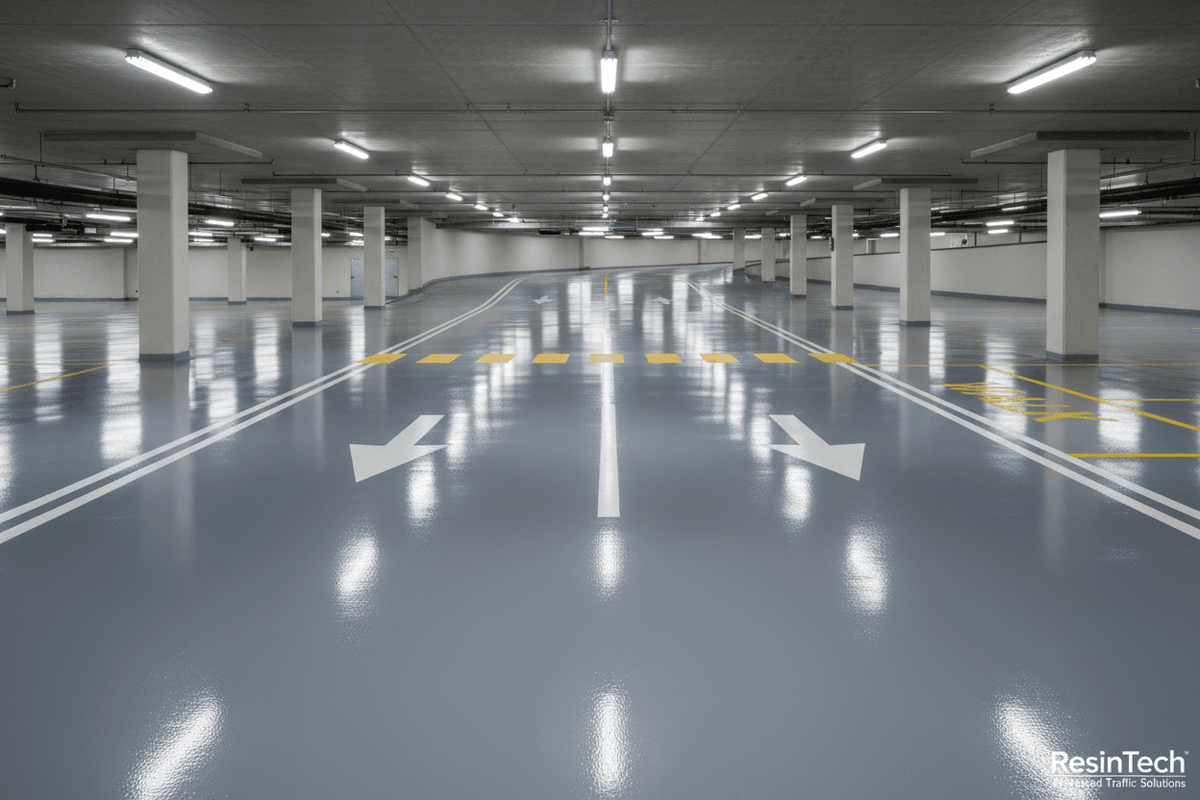
These systems are designed for the full range of trafficked concrete found in commercial, institutional, and residential structures, including parking structures, parking stalls, drive aisles, and ramps. They're equally at home on walkways, balconies, podiums, and rooftop decks.
They also handle the high-stress zones that fail first: turning zones, braking zones, and loading or service areas where abrasion and shear forces concentrate.
Across Canada, that covers a lot of ground — from downtown parkade restorations and mixed-use podium decks to suburban condo balconies and industrial service floors. Wherever foot or vehicle traffic meets exposed concrete, there's a system category built for it.
How the ResinTech System Architecture Works
The system architecture is organized by application and performance demand rather than by individual product. Each system is named to signal who and what it's built for.
Pedestrian systems carry the PTS label. Vehicular systems use VTS. The most demanding, abrasion-heavy assemblies fall under the EWS (Extreme Wear System) family.
This naming logic lets a specifier or estimator read the system code and immediately understand the traffic class, the wear protection, and whether crack-bridging is part of the build.
Choosing the Right ResinTech Traffic Coating System
System selection comes down to matching the assembly to the conditions the surface will face. The key factors are traffic intensity, abrasion demand, and turning or braking stress, along with exposure conditions and any substrate movement or crack-bridging requirements.
You'll also weigh waterproofing requirements — water-intrusion protection is provided where the specified system calls for it — and finish-media requirements where a decorative flake or quartz surface is wanted.
A pedestrian terrace and a truck-loading ramp sit at opposite ends of that spectrum. The right call depends on getting these variables right up front, which is exactly where Canopus Supply's product-selection support comes in.
ResinTech Traffic Coating System Types
PTS — Pedestrian Traffic System
The standard pedestrian assembly, built for foot-traffic areas such as pedestrian walkways, service corridors, terraces, and general pedestrian zones. It delivers a durable, UV-stable wearing surface where vehicular loads aren't a factor.
PTS+ — Pedestrian System with Crack-Bridging Base
PTS+ adds a flexible crack-bridging polyurethane base membrane to the pedestrian build. It's the choice for balconies, podiums, and rooftop pedestrian areas — particularly over occupied spaces and on movement-prone assemblies where substrate cracking is a real risk.
VTS-P — Vehicular Traffic System for Parking Stalls
VTS-P is engineered for parking stalls and lower-stress vehicular areas. It handles the static and slow-moving loads of parked and maneuvering vehicles where drive-lane abrasion isn't the dominant concern.
VTS-D — Vehicular Traffic System for Drive Lanes
VTS-D steps up to drive aisles, normal vehicle circulation paths, and moderate-traffic areas. It's built for the continuous wheel travel of everyday vehicle movement through a structure.
EWS-S — Extreme Wear System (Sand)
EWS-S introduces a sand broadcast to reinforce the surface for ramps, turning areas, and braking zones — the reinforced traffic conditions where shear and abrasion peak. The aggregate adds grip and wear capacity where standard systems would degrade faster.
EWS-F / EWS-Q — Extreme Wear Systems (Flake / Quartz)
For reinforced decorative traffic areas, EWS-F and EWS-Q use a decorative flake (F) or quartz (Q) broadcast. They combine extreme-wear performance with a finished, architectural appearance — useful where durability and aesthetics both matter.
EWS-X — Double-Broadcast Extreme Wear System
EWS-X is the maximum-duty assembly, using a double broadcast for severe ramps, truck turning zones, loading areas, and high-abrasion conditions. When a surface has to survive the worst a structure can throw at it, this is the heavy-duty end of the range.
Key ResinTech Materials Used in Traffic Coating Systems
The systems are built from a focused set of high-performance materials, each with a defined role in the assembly.
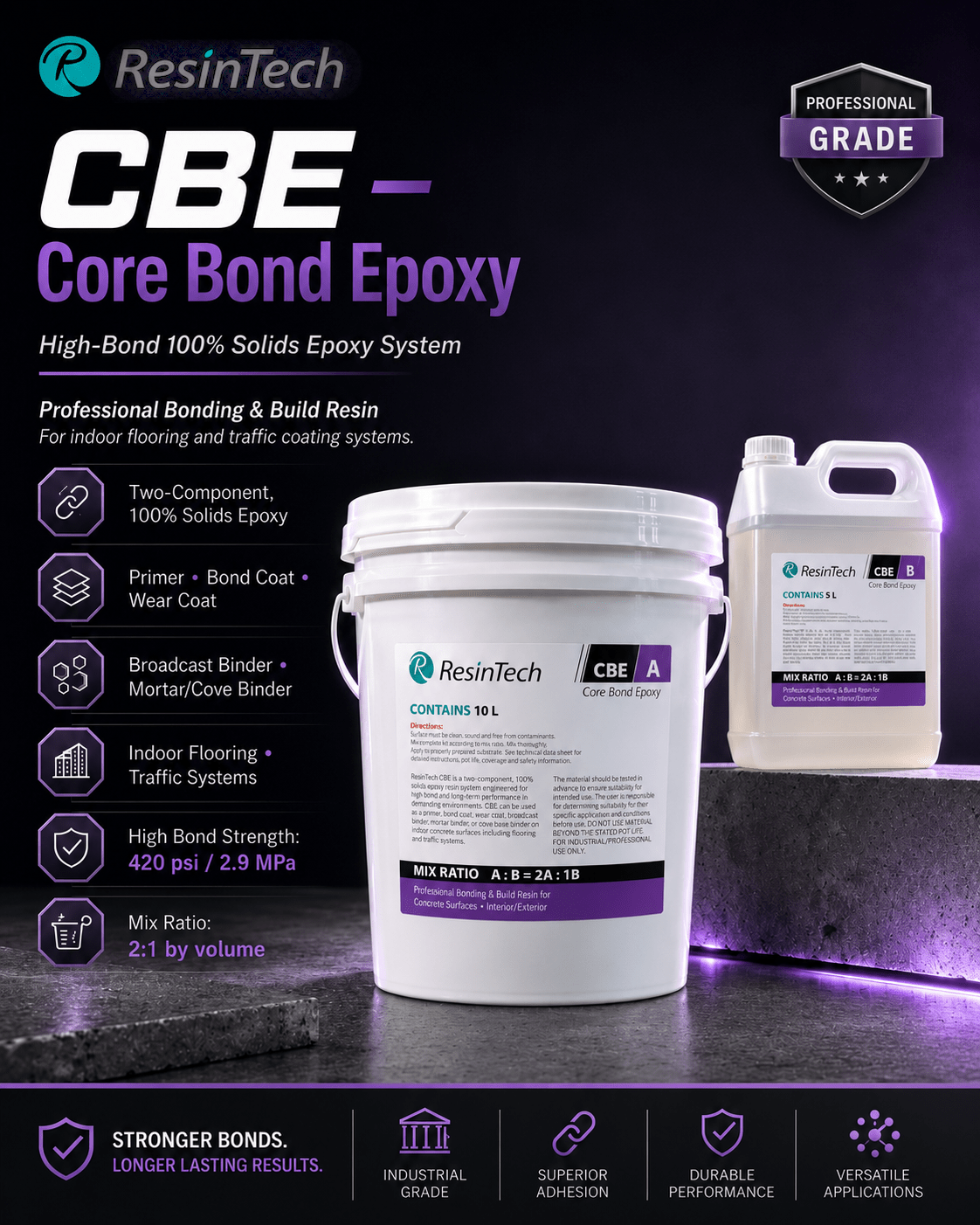
A Single-Component Polyurethane Crack-Bridging Base Membrane provides the flexible, movement-accommodating layer in "+" systems. CBE Core Bond Epoxy serves as the bonding primer that ties the system to the prepared substrate, while TUE Premium Epoxy builds the structural film of the assembly.
For the wearing surface, HPP High Performance Polyaspartic is the primary UV-stable traffic topcoat. CRU Chemical Resistant Urethane can be specified as a protective topcoat where added abrasion resistance, UV resistance, chemical resistance, and extended service life are required.
For exact mixing ratios, coverage rates, recoat windows, and application limits, contractors should confirm against each product's individual ResinTech TDS.
Why Surface Preparation and Quality Control Matter
No coating system outperforms the surface it's bonded to. Proper preparation is non-negotiable: concrete should be structurally sound, clean, dry, free of contaminants, and mechanically prepared to the required concrete surface profile (CSP).
Quality control then protects the investment through defined hold points — substrate profile verification, moisture verification, coating-thickness confirmation, broadcast acceptance, and recoat-window compliance, plus mock-up or test-patch approval where the project calls for it.
Hitting these hold points is what keeps a system on specification and consistent with the manufacturer’s warranty conditions. Skipping them is the most common reason traffic coatings fail early.
Why Buy ResinTech Traffic Coating Systems from Canopus Supply?
Canopus Supply is a Canadian source for professional concrete coatings, epoxy, polyaspartic, polyurethane, traffic coatings, waterproofing products, sealers, and the concrete-preparation equipment and tools that go with them — including rentals.
We work with contractors, installers, builders, property managers, consultants and facility managers. That means we hold the stock, supply current manufacturer documentation, and set up contractor pricing so the products are on site when the crew is. Product selection and system specification remain the responsibility of the installer, project specifier and manufacturer documentation.
From parkade restoration crews to flooring installers and the engineers who specify the work, Canopus Supply is built to keep your traffic-coating projects moving.
Talk to Canopus Supply for ResinTech stock, contractor pricing and current manufacturer documentation. Contact us today to discuss your next parkade, balcony, deck, or industrial floor order. Call 250-233-3000.
Technical Data Sheet
For full technical specifications, mixing ratios, coverage rates, recoat windows, and application limits, download the ResinTech Traffic Coating Systems data sheet below. Always confirm against the current Technical Data Sheet before specifying or applying.
PDF · Architecture & system reference
ResinTech products are distributed in Canada by Canopus Supply Inc., North Vancouver, BC. Technical specifications, recoat windows, and application limits are subject to change — always refer to the current ResinTech Technical Data Sheet for each product before specifying or applying.
Step-by-Step Application Sequence
A complete ResinTech traffic coating assembly is typically built in five to seven layers, depending on the system selected, the level of traffic, and the condition of the substrate. Pedestrian and light-traffic areas often use a streamlined build, while vehicular parkades and high-exposure decks use the full sequence. Always confirm the required layers against the ResinTech TDS and the project specification.
1. Crack & Joint Repair — PPM-SL
A semi self-leveling sealant flows into cracks, control joints, and surface defects, bridging minor movement before coating begins.
2. Prime Coat — CBE (Core Bond Epoxy)
A penetrating epoxy primer that seals the concrete, consolidates weak laitance, and maximizes adhesion for the layers above.
3. Base & Membrane Layers — TUE and PPM
A 100% solids transparent epoxy base coat builds film and locks in the system, followed by a protective polymer membrane that adds waterproofing and crack-bridging where the assembly calls for it. On waterproofing-first builds, a flexible polyurethane membrane may be specified as a base layer.
4. Topcoat & Finish — HPP, TCU or CRU
A fast-cure polyaspartic or UV-stable urethane finish provides abrasion resistance, chemical resistance, and the wearing surface. The exact topcoat is chosen for the traffic type and exposure.
Frequently Asked Questions
Do I need every layer on every project?
No. The full assembly is generally specified for vehicular parkades and high-exposure decks. Pedestrian balconies and light-traffic floors often use a simplified build. Confirm the required layers against the ResinTech TDS and your project engineer.
Can the system be applied in cold BC weather?
The epoxy components (CBE, TUE) generally require a minimum application temperature of about 10°C. Below this, cure slows and adhesion can be compromised. In cooler months, ensure the substrate has warmed sufficiently and maintain temperature through cure. Always confirm against the current TDS.
How soon can the deck reopen to traffic?
Cure times vary with temperature, topcoat, and TDS. As a general guide, polyaspartic topcoats can allow light foot traffic within several hours, while vehicular traffic typically requires roughly 24–48 hours for full cure. Confirm exact reopening times against the product TDS for your conditions.
Is the system compatible with drains and expansion joints?
Yes, with correct detailing. Control joints can be sealed with PPM-SL, but expansion joints should not be bridged by the coating — install backer rod and the appropriate joint sealant before coating, per the project specification.
Where can I buy the ResinTech traffic coating system in BC?
Canopus Supply is an authorized ResinTech distributor in British Columbia. Local pickup is available in North Vancouver. We deliver across Greater Vancouver and BC, and we ship eligible products across Canada and the USA. For heavy, oversized, special-order, hazardous, or contractor-volume orders, shipping must be confirmed before fulfillment. Contact us at 250-233-3000 to confirm stock or request contractor pricing.
Technical information is provided for professional reference only. Product selection, substrate preparation, installation method, coverage, cure time, system compatibility and final performance remain the responsibility of the purchaser, installer, project specifier and/or manufacturer documentation. Always confirm suitability against the current TDS, SDS, project specification and site conditions before use.